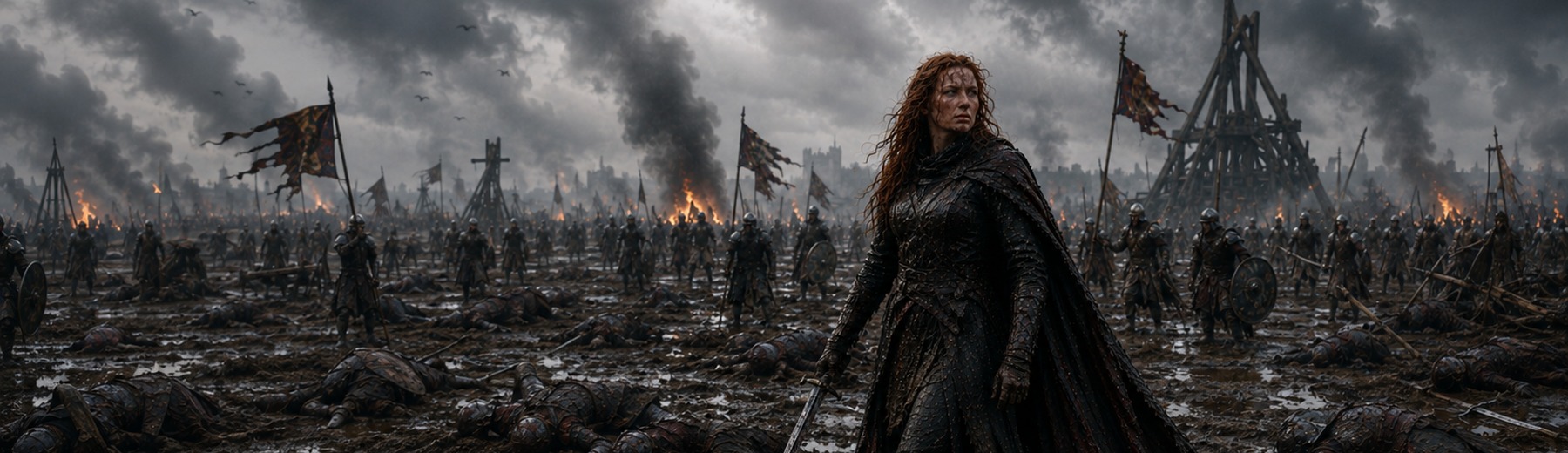
Banishment and the open road
Evelyne leaves the northern settlement that formed her, taking Ashborn and very little certainty with her.
A reputation nobody planned
She becomes known through skirmishes, escorts, local disputes and the kind of fighting that rarely reaches royal chronicles but determines whether ordinary families survive the season. She also develops an unfashionable preference for foul weather. If rain, wind and mud made the enemy slower, colder and less certain, she saw no reason to wait for sunshine. Years later, accounts begin referring to Evelyne herself as the Storm.
The loss of home
Her parents are killed when the forge burns. The event becomes one of the great dividing lines in her life: before it, Evelyne still had somewhere to return to; afterwards, home became something she had to build from people rather than place.
From survivors into a company
The group around her hardens into something with a name, a crest and a code. They are not spotless heroes. They are people bound by the decision to stand where others have been abandoned — and trained to function in the rain, mud, wind and poor visibility that other commanders preferred to wait out.
The equal beside her
Rael becomes the other commander of the Ashen Guard — not Evelyne’s subordinate and not her keeper. Their strengths are different enough to cause arguments and complementary enough to keep people alive. The surviving accounts make clear that the bond between them became deeply personal; the rest belongs to the longer chronicle.
A life protected by distance
The stories surrounding Evelyne’s child are among the most guarded. Tradition holds that the child was hidden for safety, creating a private wound beneath the public legend.
“You do not summon me.”
By the time royal authority notices Evelyne, she is already somebody who cannot easily be ordered. The York audience becomes one of the defining stories of her relationship with power.
An uncomfortable respect
Evelyne’s path crosses that of the young Edward. Neither is entirely comfortable with the other. The surviving tales suggest recognition, irritation and a mutual respect earned rather than granted by rank.
The woman after the battles
Older accounts become quieter: the manor, the Guard Hall, the willow, the lake, the names of the dead and a woman learning that surviving a war does not mean the war immediately leaves you.
From woman to story
Her grave, if the traditional site is hers, is modest. Her influence is not. The stories travel farther than any monument could.
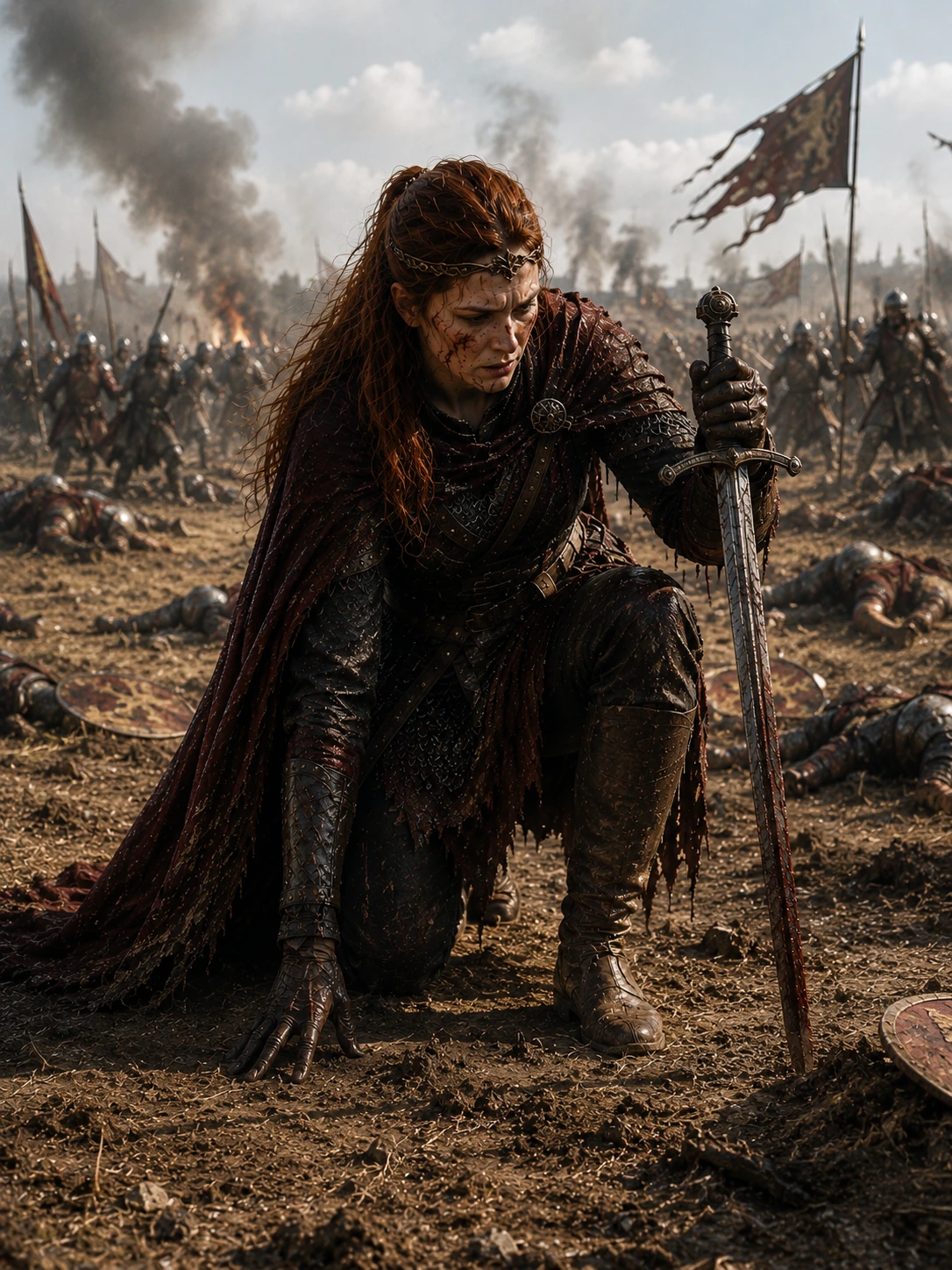
She was seen on her knees.
The most important Evelyne story may not be a victory at all. It is the recurring image of her exhausted, wounded and kneeling with Ashborn planted in the earth.
Because the next part is always the same.
She stands.