
She was not a saint.
The oldest accounts describe somebody stubborn, sharp-tongued and almost allergic to ceremony. She could be compassionate one moment and terrifying the next. She had fire in her before she had the discipline to carry it safely. As a girl and young woman she was quick to step between cruelty and the person receiving it — and sometimes far too quick to believe that being willing to fight made the fight itself wise.
She disliked being summoned, mistrusted polished men with easy promises and judged people by what they did when nobody important was watching. She was called Lady, though the title never sat comfortably on her. In many stories she remains simply Evelyne: the red-haired blacksmith’s daughter who had to learn that courage, anger and justice are not the same thing — and who, oddly enough, was often happiest when the weather was foul. Rain flattened banners, mud stole speed and thunder unsettled horses. Evelyne learned to treat all of that as part of the ground rather than a reason to avoid it.
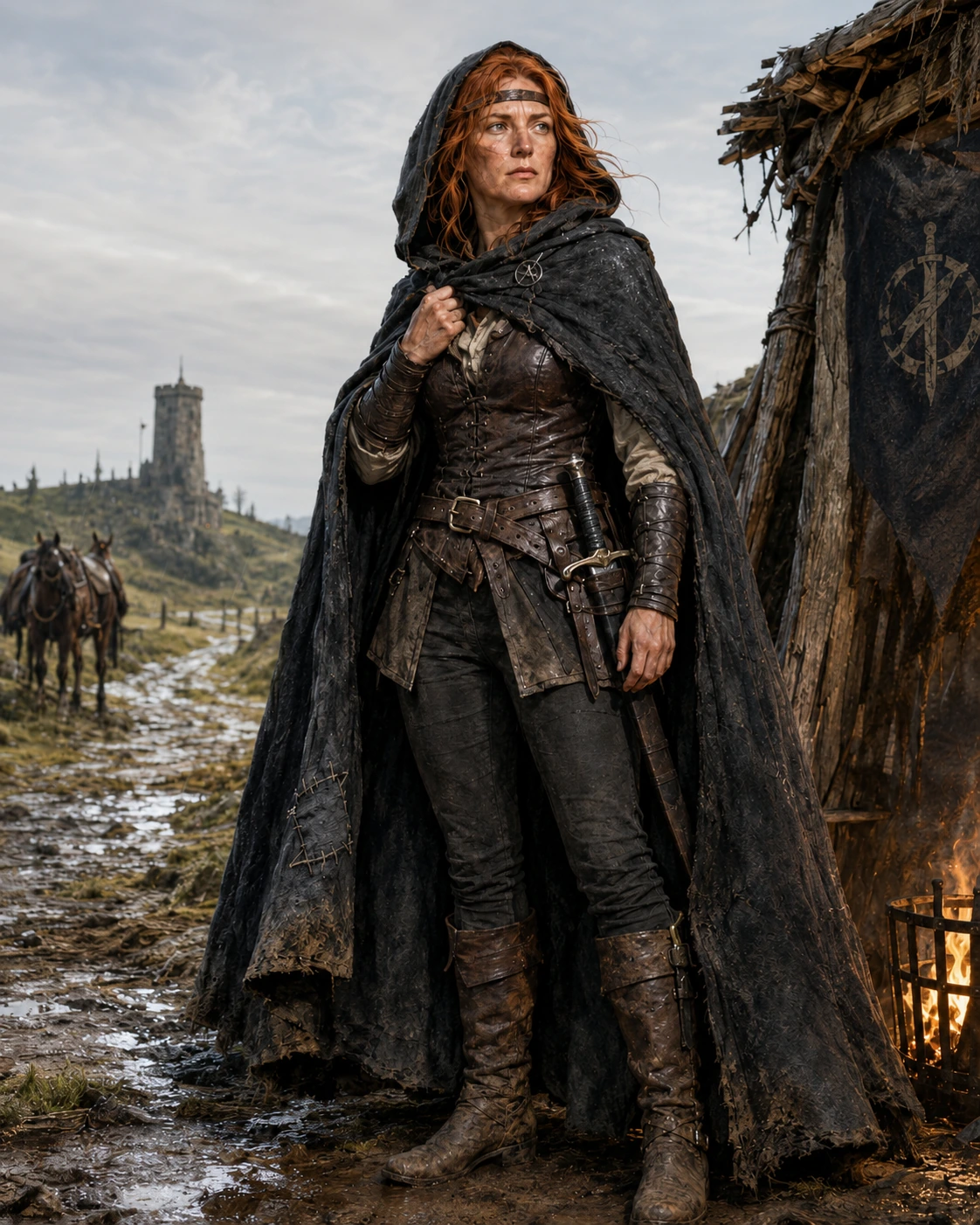

She was fierce long before she was wise.
At twelve, she stepped between village boys and an injured fox and broke the ringleader’s nose. The protection was real. So was the satisfaction she took from hitting him. Her mother, Maren, refused to let her hide one truth inside the other.
Years later, that same instinct became far more dangerous. A fast victory taught young fighters to follow her because she fought at the front and seemed to see an answer before everyone else. Evelyne began to believe speed and fury were the same thing as command.
They were not.
Some of the dead were hers to answer for.
Protection or temper?
Maren’s question followed Evelyne for years: did she protect the weak, or had she simply found somewhere respectable to put her anger?
Bravery was not enough.
At about twenty-one, Evelyne ignored an older scout’s warning and chased an orderly retreat into a prepared lane. Concealed archers and spearmen closed around her small company. Roughly half were killed or mortally wounded.
She went to the families.
She recovered the bodies she could, faced the people who had trusted her with their sons and companions, and did not ask to be forgiven. She admitted that she had mistaken the ground, the enemy and her own certainty.
She had to learn to stop.
Tomas taught her as a child that a blade too hard will shatter. Maren taught her something harder: standing between people and harm also means knowing when the fight has ended.
What made her Evelyne
She stayed.
Not because she was never afraid, but because she could not always persuade herself to leave somebody else to face the thing alone.
She had to learn where fury ended.
Evelyne could be violent when she believed it necessary — and, especially when she was young, there were moments when striking back felt satisfying. Part of her growth was learning to distrust that satisfaction rather than dress it up as justice.
Titles did not impress her.
Kings, commanders and nobles received roughly the same courtesy as everyone else — provided they behaved like people worth respecting.
Once you were hers, you were hers.
The Ashen Guard was built less like an army and more like a collection of people who had nowhere else to stand.
She broke.
That matters. She grieved, doubted, collapsed and sometimes withdrew. Her legend grew because she returned, not because she was untouched.
She preferred bad weather.
Not from romance. From practice. Evelyne learned to move, ride and fight when rain, wind and mud made everybody miserable. She trained the Ashen Guard to do the same. In later accounts, “the Storm” becomes almost as recognisable as the red hair and battered cloak.
She preferred the storm.
Evelyne did not merely endure foul weather. She learned to use it.
Rain, wind, mud and poor visibility slowed everybody. Horses lost their footing. Leather grew heavy. Hands went numb. Men became cold, miserable and uncertain. Most commanders preferred to wait for better conditions.
Evelyne looked at the same weather and asked a different question:
So she trained in it. Rode in it. Learned how Seal moved when the road became treacherous, how long men could stay useful in driving rain, and how quickly confidence disappeared when an enemy had prepared only for a clean field.
Later, she made the Ashen Guard train the same way. Wet leather, cold hands, churned ground and poor visibility became ordinary rather than exceptional. They learned to move when other companies were still deciding whether the weather was bad enough to postpone the day.
This was not bravado and it was not romance. Evelyne understood that the storm belonged to both sides. The advantage went to the people who had prepared for it.
Over time, the sight became familiar: red hair darkened by rain, the old battered cloak soaked through, Seal beneath her, the Guard coming on through weather everyone else wished would pass.
Some later accounts stopped describing Evelyne as a woman riding through a storm.
They simply called her the Storm.
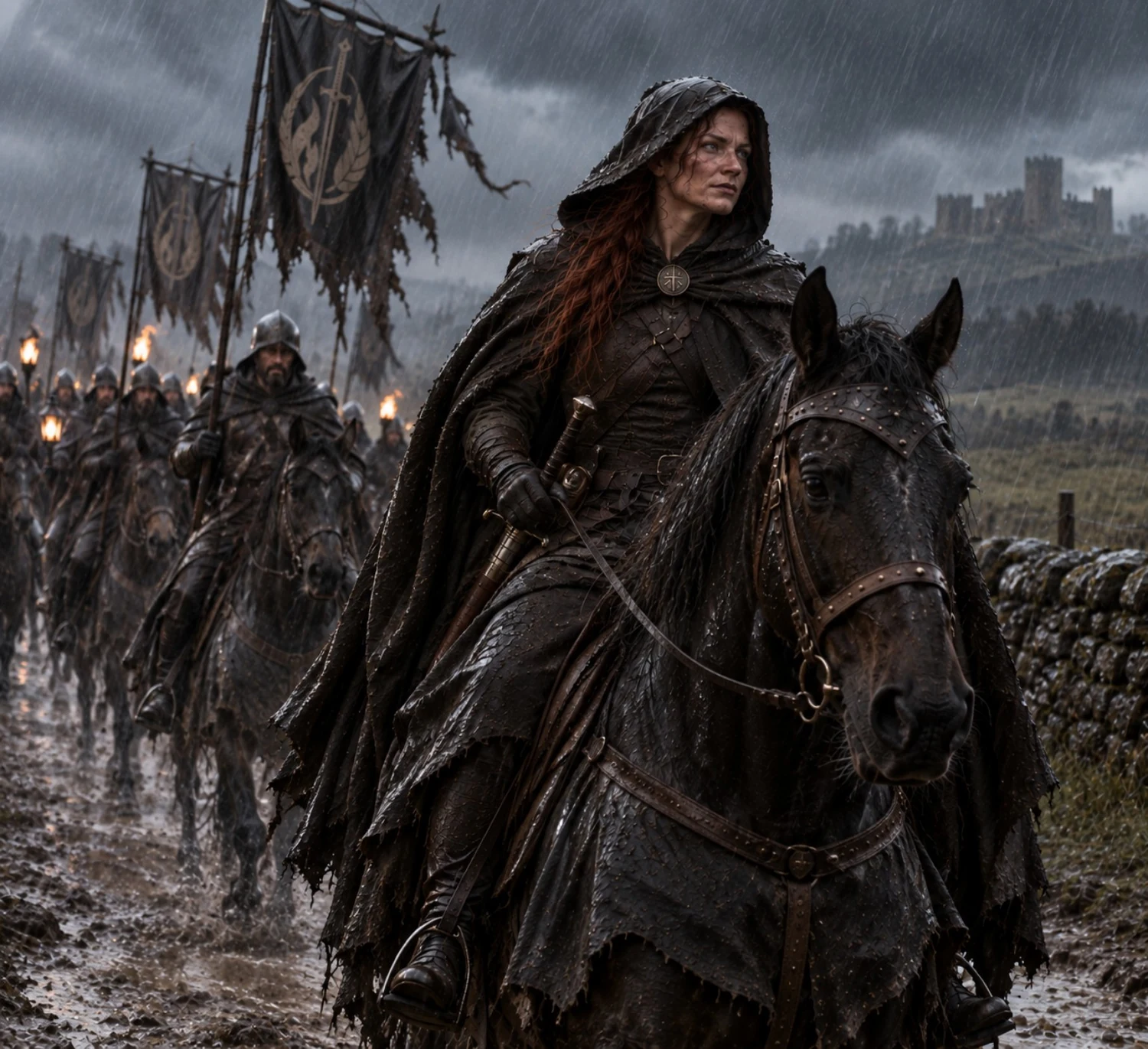
Ashborn. Seal. Rael.
Some names recur so often in the surviving stories that they become part of Evelyne’s silhouette. The website gives enough to know who they are. The deeper stories belong to the chronicle.
Not a ceremonial horse.
Seal was built into Evelyne’s working life: road miles, mud, battle, bad footing and weather that sent more comfortable riders looking for shelter. Their partnership makes the storm stories feel less like theatre and more like habit.
Forged before the legend.
Ashborn began with Tomas, iron, patience and a girl who wanted a sword long before she understood what carrying one would ask of her. It remained at Evelyne’s side through triumph, failure and the long education of command.
Named for willow.
Evelyne’s dark mare is remembered as Seal. The name is generally linked in the later telling to the Old English sealh — sallow or willow. The spelling softened in the stories; the meaning remained.
Willow suited her: strong without needing to be rigid, able to bend through foul weather without breaking.
Beside her, never beneath her.
Rael was never Evelyne’s deputy, keeper or sensible man sent to control her. He was an equal commander of the Ashen Guard. Evelyne read the immediate danger; Rael often saw the road beyond it — routes, supply, weather, withdrawal and consequence.
They argued, corrected one another and became inseparable in the accounts that survive. What passed between them belongs to the longer chronicle.
She asked for them.
In the stories, Evelyne has a habit that is easy to miss beside the battles and the legends. She asks people their names.
Soldiers. Servants. The wounded. Frightened strangers on a road. People everyone else has already reduced to a problem, a burden, a casualty or a number.
A name does not mend a wound. It does not bring the dead home. But once someone has told you their name, it becomes a little harder to pretend they are nobody.
That small habit has been carried into the library here. If you sit down to speak with Evelyne, she will ask yours too.
Perhaps that is the wrong question.
The accounts surrounding Evelyne are contradictory. Some read like campaign records, some like family memory, some like tavern stories improved by a hundred retellings. Names change. Places move. Dates refuse to behave.
Yet across them, the same woman keeps appearing: a red-haired rider on a dark mare, a scarred sword, a black feather, the same battered leather cloak repaired through years of foul weather — and the refusal to abandon people simply because the powerful had decided they were expendable. In some northern retellings she is simply called the Storm.
She did not become wise by ceasing to be fierce. The fire remained. What changed was her willingness to question it, to listen, to admit error and — when necessary — to choose patience over the glorious stupidity of another charge.